Updated 10 November 2026 by Anna Hamer
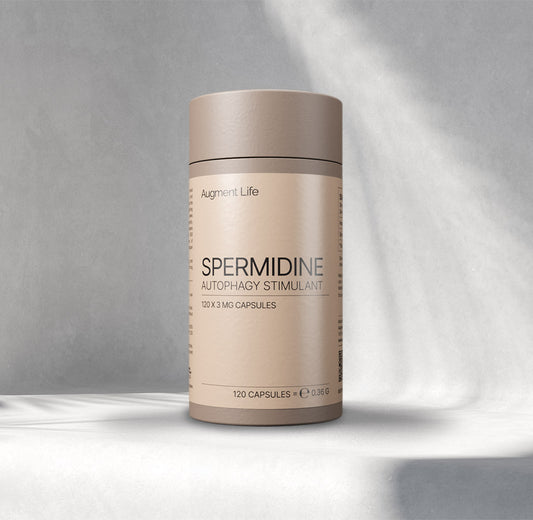
Spermidine is a natural compound found in almost all living cells and in foods such as soybeans, mushrooms and wheat germ. In animals it has been linked to longer lifespan, which is why it has become one of the more talked-about longevity supplements.
But what does the research in people show so far? Here is what we know about how spermidine works, where it comes from, what the human studies found and what they did not.
What is Spermidine?
Spermidine is an essential polyamine compound necessary for cellular growth, differentiation, and apoptosis or programmed cell death. First identified in human semen, spermidine occurs in many foods, such as:
- soybeans,
- mushrooms,
- aged cheese,
- wheat germ.
Spermidine is part of a broader group of compounds called polyamines, along with putrescine and spermine, which participate actively within cells and are a necessary component for health and longevity (1).
Functions of Spermidine in the Body
Spermidine, being a polyamine, is associated with many important biological events (2, 3):
-
Cellular Metabolism: Spermidine assists in a range of metabolic activities, including that of nucleic acids (particularly in DNA and RNA synthesis). These processes are essential for cell division and repair hence promoting the health of cells and life in general.
-
Autophagy: The most striking role of spermidine is that it induces autophagy – the process by which cells destroy and recover parts that have become damaged or nonfunctional. This is important in the renewal and restoration of cells, and autophagy tends to become less efficient with age. In laboratory and animal studies, spermidine has been shown to stimulate autophagy (4).
-
Mitochondrial Function: Polyamines, particularly spermidine, have been shown to be a mitochondrial and cellular protector. Mitochondria are considered the powerhouses of cells and maintain energy output while sustaining the cell's overall activity (4).
If you want to learn more about autophagy, read The Role of Autophagy in Health and Longevity.
Spermidine - Health Benefits
1. Longevity
A number of research studies show that spermidine may be associated with an extended lifespan. In a large study that followed 829 adults for about 20 years, higher dietary spermidine intake was linked to a decreased risk of mortality: those who ate the most were less likely to die over that time than those who ate the least (5). This looked at spermidine from food, not supplements, and it can't prove spermidine was the reason, since people who eat more of it tend to eat healthier overall.
In animals, spermidine has extended lifespan in yeast, worms, flies and mice (6). We don't yet know if it does the same in people.
2. Cardiovascular Health
Studies suggest that people who eat more spermidine tend to have lower blood pressure and a lower risk of cardiovascular disease (6). In older mice, spermidine also helped the heart work better. This suggests that eating foods rich in spermidine could be protective for the heart, but it does not show that spermidine supplements do the same.
3. Neuroprotection and Cognitive Function
Spermidine has shown some promise for brain function in older adults, but the results are mixed. In a small 3-month study of 30 older adults with memory worries, those given a spermidine-rich plant extract showed a moderate improvement in memory compared with those who weren't given it (7). However, a larger one-year study of 100 people taking a smaller daily dose (0.9 mg) found no difference in memory (8). For now, it is too early to say that spermidine improves memory.
4. Immune Function
This is a newer area of research. In a small Oxford study, 40 adults over 65 took either 6 mg of spermidine a day or a capsule with no spermidine in it for 13 weeks after a COVID-19 booster. It was well tolerated. Overall antibody levels did not rise significantly, but in the 8 people who had responded poorly to the vaccine, spermidine boosted their antibody responses (9). It is an encouraging early sign from a very small group, and more research is needed. The supplement came from its manufacturer, which also helped fund the work.
5. Hair and Skin Health
Spermidine has been associated with hair growth. In the lab, it helped human hair follicles keep growing for longer (10). It has not yet been shown to prevent hair loss in people, and there is little evidence so far for skin health or a younger appearance.
Food Sources of Spermidine
Spermidine is present naturally in various foods, especially in plant-based sources. The figures below come from a Swedish food polyamine database and show spermidine per typical portion. Actual amounts vary widely with variety, ripeness, storage and preparation (11).
-
Soy: cooked soybeans contain about 9.7 mg per 190 g portion. Fermented soy products such as natto are also reported to contain considerable amounts of polyamines (5, 11), although the database does not give a natto figure.
-
Green peas: about 9.1 mg per 140 g serving.
-
Mushrooms: about 4.4 mg per 50 g (the database lists mushrooms generally, not a specific type).
-
Broccoli: about 3.6 mg per 100 g.
-
Cheese: about 2.0 mg per 20 g portion. Matured cheeses generally contain more polyamines than fresh ones.
-
Whole grains and wheat germ: contain varying amounts. Wheat germ is one of the richest sources, while refined white flour contains much less.
Adding spermidine-rich foods to your diet is a natural way to increase your intake.
Spermidine - Recommended Dosage
Currently, no official recommended daily intake exists for spermidine, as it is in an early stage of research. However, the European Union's Food and Safety Authority recommends not exceeding a daily dosage of 6 mg (12). This guideline helps to ensure prevention of potential side effects and ensures safe consumption levels.
Although food sources of spermidine seem to offer sufficient dietary intakes, people who want to get even higher amounts or have specific health concerns might find supplementation a good idea.
Before adding a new supplement, however, a healthcare professional should be consulted to determine the appropriate dose and whether it can be combined with your existing medications.
Spermidine - Side Effects
Spermidine appears to be well tolerated at the doses studied, including amounts found in food and in short-term supplement trials (9, 13). Rarely, some people may experience gastrointestinal upset, such as bloating or nausea.
Two cautions:
-
Limited long-term data. Human trials so far are short and small.
-
Cancer. Polyamines are involved in cell growth, and spermidine's effect in people with cancer is not well understood (4). If you have a cancer diagnosis, take regular medication, or are pregnant or breastfeeding, speak to your doctor before taking a supplement.
Monitor how you feel when starting any supplement, and adjust the dose or stop if you have negative effects.
The Takeaway
Spermidine helps cells clear out damaged parts (a process called autophagy), and it has helped animals live longer. In people, eating more of it has been linked to a longer life, and a few small tests hint at benefits, but the results are mixed. It is promising but early, and we can't yet call it a proven longevity supplement. In the meantime, getting more spermidine from food (soy, mushrooms, peas, beans, whole grains, wheat germ) is a reasonable, low-risk approach.
Food supplements are not a substitute for a varied, balanced diet and a healthy lifestyle. This article is not medical advice.
Read More
Literature Sources
- Bardócz S, Duguid TJ, Brown DS, Grant G, Pusztai A, White A, et al. The importance of dietary polyamines in cell regeneration and growth. British Journal of Nutrition. 1995;73(6):819-828. https://doi.org/10.1079/bjn19950087
- Igarashi K, Kashiwagi K. Modulation of cellular function by polyamines. The International Journal of Biochemistry & Cell Biology. 2010;42(1):39-51. https://doi.org/10.1016/j.biocel.2009.07.009
- Pegg AE. Functions of polyamines in mammals. Journal of Biological Chemistry. 2016;291(29):14904-14912. https://doi.org/10.1074/jbc.R116.731661
- Madeo F, Eisenberg T, Pietrocola F, Kroemer G. Spermidine in health and disease. Science. 2018;359(6374):eaan2788. https://doi.org/10.1126/science.aan2788
- Kiechl S, Pechlaner R, Willeit P, Notdurfter M, Paulweber B, Willeit K, et al. Higher spermidine intake is linked to lower mortality: a prospective population-based study. American Journal of Clinical Nutrition. 2018;108(2):371-380. https://doi.org/10.1093/ajcn/nqy102
- Eisenberg T, Abdellatif M, Schroeder S, Primessnig U, Stekovic S, Pendl T, et al. Cardioprotection and lifespan extension by the natural polyamine spermidine. Nature Medicine. 2016;22(12):1428-1438. https://doi.org/10.1038/nm.4222
- Wirth M, Benson G, Schwarz C, Köbe T, Grittner U, Schmitz D, et al. The effect of spermidine on memory performance in older adults at risk for dementia: a randomized controlled trial. Cortex. 2018;109:181-188. https://doi.org/10.1016/j.cortex.2018.09.014
- Schwarz C, Benson GS, Horn N, Wurdack K, Grittner U, Schilling R, et al. Effects of spermidine supplementation on cognition and biomarkers in older adults with subjective cognitive decline: a randomized clinical trial. JAMA Network Open. 2022;5(5):e2213875. https://doi.org/10.1001/jamanetworkopen.2022.13875
- Alsaleh G, Ali M, Kayvanjoo AH, Liu F, Moreau T, Bibi S, et al. Spermidine mitigates immune cell senescence and boosts vaccine responses in healthy older adults: a pilot study. Aging Cell. 2026;25(6):e70545. https://doi.org/10.1111/acel.70545
- Ramot Y, Tiede S, Bíró T, Abu Bakar MH, Sugawara K, Philpott MP, et al. Spermidine promotes human hair growth and is a novel modulator of human epithelial stem cell functions. PLoS One. 2011;6(7):e22564. https://doi.org/10.1371/journal.pone.0022564
- Atiya Ali M, Poortvliet E, Strömberg R, Yngve A. Polyamines in foods: development of a food database. Food & Nutrition Research. 2011;55:5572. https://doi.org/10.3402/fnr.v55i0.5572
- European Commission. Commission Implementing Regulation (EU) 2017/2470 of 20 December 2017 establishing the Union list of novel foods. Official Journal of the European Union. 2017;L 351. https://eur-lex.europa.eu/legal-content/EN/TXT/PDF/?uri=CELEX:32017R2470
- Schwarz C, Stekovic S, Wirth M, Benson G, Royer P, Sigrist SJ, et al. Safety and tolerability of spermidine supplementation in mice and older adults with subjective cognitive decline. Aging. 2018;10(1):19-33. https://doi.org/10.18632/aging.101354