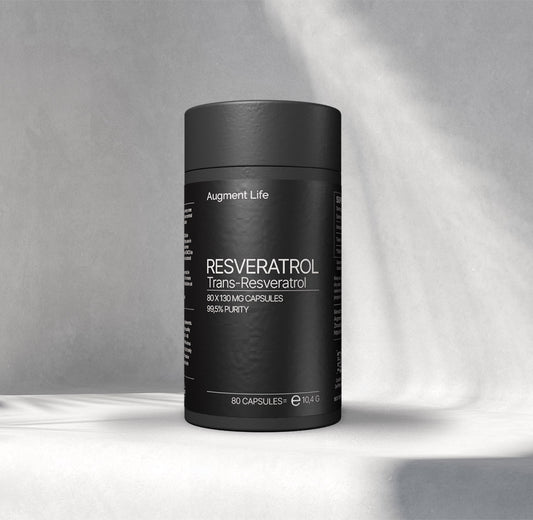
Resveratrol is a powerful antioxidant found in foods such as grapes, blueberries, and peanuts. Over the past two decades, it has become one of the most researched compounds in longevity science because researchers discovered it influences SIRT1, one of the body's best-known proteins involved in cellular repair and healthy ageing. This finding sparked decades of research into whether resveratrol could help support the biological processes that change as we grow older (2,6).
One challenge has followed resveratrol throughout that research: only a small fraction of an oral dose reaches the bloodstream in its original form. Most is rapidly metabolised before absorption, making delivery just as important as dosage (1,2).
What Are the Potential Benefits of Resveratrol?
Researchers have investigated resveratrol for its potential to support cardiovascular health, metabolic function, healthy blood vessel function, and some of the cellular pathways associated with ageing (2,6). While results have been mixed, poor bioavailability is widely recognised as one of the main factors limiting its effectiveness after oral supplementation (1,2).
In human studies, resveratrol supplementation has been associated with measurable physiological effects across different populations and doses, including reduced LDL and oxidised LDL in cardiovascular risk patients (350 mg grape extract), reduced inflammation and oxidative stress markers in Polyendocrine Metabolic Ovarian Syndrome (PMOS/PCOS) (800 mg/day), improved metabolic and calorie-restriction-like effects in obese adults (150 mg/day), and slowed bone loss in post-menopausal women (75 mg twice daily) (7-9).
Why Standard Resveratrol Is Poorly Absorbed
After ingestion, resveratrol is rapidly broken down in the gut and liver into metabolised forms that have lower biological activity than the original compound (1,2).
A meta-analysis of 84 oral dosing studies shows that higher doses of resveratrol increase circulating levels, but the compound is still rapidly metabolised, resulting in consistently low systemic exposure across dose ranges (1).
In practical terms, simply increasing intake does not reliably solve the absorption challenge once metabolism becomes the limiting step.
How Liposomal Delivery Changes Absorption
Liposomes are phospholipid-based carriers designed to protect active compounds during digestion and improve transport through the intestinal barrier (2).
Liposomal delivery has attracted attention because it tackles one of resveratrol's biggest limitations: getting enough of the active compound into circulation. Although dedicated human studies on liposomal resveratrol are still limited, research on liposomal vitamin C, glutathione, and multivitamins has consistently shown improved absorption compared with conventional formulations (3–5).
This is one reason liposomal delivery is becoming increasingly popular across longevity supplements.
Read more on liposomal formulations in our previous articles: Are Liposomal Formulations of Supplements Better?, Berberine: Does Liposomal Make a Difference?
How Much Should You Take?
There is currently no established clinical consensus for liposomal resveratrol dosing, as direct human studies comparing different doses are still lacking (1,2).
Most human studies of conventional resveratrol have used between 100 and 500 mg per day. In controlled human research, doses in this range have been associated with measurable effects on metabolic function, including improvements in insulin sensitivity, blood lipids, and markers of liver fat, alongside activation of key longevity-related pathways such as SIRT1 and AMPK (1,6).
Because liposomal formulations are designed to improve absorption, many provide 100 to 250 mg of active resveratrol, aiming to achieve similar exposure without relying on larger doses.
Augment Life's Liposomal Resveratrol provides 250 mg of active resveratrol, a dose that sits at the upper end of the evidence-informed range discussed above. It is delivered using a cholesterol-free co-loading system made from Non-GMO sunflower lecithin and rare ginsenosides, designed to support efficient delivery without relying on very high doses.
Taking more is not necessarily better. Once absorption becomes the limiting factor, larger doses are more likely to increase digestive side effects than meaningfully raise circulating resveratrol levels (1).
Some people also pair resveratrol with nicotinamide riboside (NR) because both have been studied in healthy ageing research. However, clinical evidence evaluating the combination in humans is still limited.
Read more about resveratrol and NR in our previous articles: Why Is Resveratrol Important?, How Much Nicotinamide Riboside Should I Take?, What is better, NMN or NR?
The Bottom Line
There is no universally "optimal" dose of liposomal resveratrol yet, because the necessary human studies have not been completed. What the evidence does suggest is that better absorption may reduce the need for the very high doses often used with conventional resveratrol.
As our understanding of healthy ageing continues to grow, improving how compounds are delivered may prove just as important as discovering new ones. For resveratrol, that shift has already begun.
Literature Sources
- Szymkowiak I et al. Resveratrol Bioavailability After Oral Administration. Phytotherapy Research. 2025;39(1):453–464. https://doi.org/10.1002/ptr.8379
- Chimento A et al. Progress to Improve Oral Bioavailability of Resveratrol. International Journal of Molecular Sciences. 2019;20(6):1381. https://doi.org/10.3390/ijms20061381
- Purpura M et al. Liposomal Vitamin C Absorption Study. European Journal of Nutrition. 2024;63(8):3037–3046. https://doi.org/10.1007/s00394-024-03487-8
- Sinha R et al. Liposomal Glutathione Study. European Journal of Clinical Nutrition. 2018;72:105–111. https://doi.org/10.1038/ejcn.2017.132
- Ko J et al. Liposomal Multivitamin Pharmacokinetics. Nutrients. 2023;15(13):3073. https://doi.org/10.3390/nu15133073
- Timmers S et al. Resveratrol and Metabolic Effects in Humans. Cell Metabolism. 2011;14(5):612–622. https://doi.org/10.1016/j.cmet.2011.10.002
- Tomé-Carneiro J. et al. “Consumption of a grape extract supplement containing resveratrol decreases oxidized LDL and ApoB in cardiovascular risk patients.” Molecular Nutrition & Food Research (2012). https://doi.org/10.1002/mnfr.201100673
- Wong R.H.X. et al. “Regular Supplementation With Resveratrol Improves Bone Mineral Density in Postmenopausal Women.” Journal of Bone and Mineral Research (2020). https://doi.org/10.1002/jbmr.4115
- Brenjian S. et al. “Resveratrol treatment in patients with polycystic ovary syndrome decreased pro-inflammatory and endoplasmic reticulum stress markers.” American Journal of Reproductive Immunology (2020). https://doi.org/10.1111/aji.13186