Urolithin A is a compound your gut bacteria make from plant compounds in pomegranates, berries and walnuts. In worms and mice it has been linked to longer lifespan and healthier muscles, which is why it has become one of the more talked-about longevity supplements.
But what does the research in people show so far? Here is what we know about where urolithin A comes from, what the human trials found and what they did not.
What Is Urolithin A?
Pomegranates, berries and walnuts contain ellagitannins, plant compounds your body cannot absorb well on its own. Bacteria in your gut break them down into smaller molecules called urolithins, and urolithin A is the one studied most (1).
Researchers are interested in it because of mitophagy, the process cells use to clear out old or damaged mitochondria, the parts of the cell that produce energy. Mitophagy tends to slow with age, and in lab and animal studies urolithin A increases it (1, 2). We explain the wider process in The Role of Autophagy in Health and Longevity.
Urolithin A as a supplement was developed by Amazentis, a spin-off of the Swiss university EPFL in Lausanne. In this video, the researchers explain how they discovered it and how it works:
Which Foods Contain Urolithin A?
Strictly speaking, none. Foods contain the ellagitannins that your gut bacteria turn into urolithin A. The richest sources include:
Pomegranates and pomegranate juice
Berries, such as raspberries, strawberries and blackberries
Walnuts
How much urolithin A you get from these foods depends on which bacteria live in your gut. Researchers group people into three types: those who make mainly urolithin A, those who also make other urolithins, and those who make none. In a study of 839 people aged 5 to 90, age was the main factor deciding which type someone was (3). In a smaller study of 35 healthy young people in China, about 1 in 7 (14%) made none (4).
This is one reason urolithin A is sold as a supplement: it gives a set amount directly, whatever your gut bacteria do.
What Does the Research on Urolithin A Show?
In worms, mice and cell studies, urolithin A has been linked to longer lifespan, lower inflammation and more mitophagy (1, 2). Since 2019, a handful of small human trials have tested whether some of this carries over to people.
Does Urolithin A Improve Muscle Strength and Endurance?
The first human trial found that 500 mg and 1,000 mg a day for 4 weeks changed blood markers of fat metabolism (acylcarnitines) and the activity of mitochondrial genes in the muscles of inactive older adults (5).
A larger trial followed 88 middle-aged adults who were overweight and inactive for 4 months. Both 500 mg and 1,000 mg a day increased hamstring strength, by about 12% and 10% respectively, compared with a placebo. Peak power output, the outcome the trial was designed around, did not change significantly. Walking distance and aerobic fitness improved only at 1,000 mg, and although the authors called these gains clinically relevant, they were not statistically significant. C-reactive protein, a blood marker of inflammation, fell (6).
In 66 adults aged 65 to 90, 1,000 mg a day for 4 months improved endurance in a hand muscle and a leg muscle, measured as the number of contractions before the muscle tired, and lowered C-reactive protein. The two outcomes the study was built to test, the 6-minute walk and the muscles' maximum energy output, did not improve significantly (7).
Athletes have been studied too. In 42 trained male distance runners, 4 weeks of 1,000 mg a day during an altitude training camp made a 3,000 m time trial feel easier and lowered markers of muscle damage afterwards, but did not improve their times (8).
A 2026 review looked at 5 trials in 236 people: the middle-aged, older adult and runner trials above, plus small trials in resistance-trained men and teenage academy footballers, both of which reported some gains in strength or fitness. Because the trials measured different things, walking distance was the only result that could be combined, and only from two trials. It leaned in favour of urolithin A without being statistically significant, and the authors rated the certainty of the evidence as low (9).
As we age, the immune system tends to have fewer "fresh" (naive) T cells, the cells that respond to new infections. In a 2025 trial in 50 healthy middle-aged adults, 1,000 mg of urolithin A a day for 4 weeks increased naive-like CD8 T cells and improved how well these cells use fat for energy (10). These were laboratory measurements of immune cells rather than fewer infections or better vaccine responses, so longer trials will need to show what they mean for health.
Does Urolithin A Help Blood Vessels?
Not on current evidence. In 50 middle-aged adults with obesity, 1,000 mg a day for 4 weeks did not improve flow-mediated dilation, a standard test of how well the arteries widen. The brain's blood-flow response during a working memory task did increase, though performance on the task stayed the same (11).
What Are the Limits of the Research?
The human trials are small, ran for 4 weeks to 4 months, and several missed the outcome they were designed to test, with the positive findings coming from secondary measures. Most were designed, funded or co-authored by Amazentis, which sells urolithin A as a supplement (5, 6, 7, 8, 10). Independent research is growing. The blood vessel trial, for example, was funded by the American Heart Association and the Reynolds Foundation, and its authors reported no conflicts of interest (11). The research is promising, but it is early. If you want to judge studies like these yourself, see How to Tell a Good Study from a Bad One.
Does Urolithin A Have Side Effects?
None of note so far. The first human trial was designed mainly to test safety, and urolithin A was well tolerated at every dose given, including single doses of up to 2,000 mg (5). In the trial in older adults, side effects were no more common with urolithin A than with a placebo (7). A 2024 systematic review of 5 studies in 250 healthy people found no serious side effects, and those reported were mild or moderate (12).
The trials lasted 4 months at most, so there is no data yet on taking it for years. They also did not include pregnant or breastfeeding women or people with serious health conditions. If you take medication or have a medical condition, check with your doctor or pharmacist before starting.
How Much Urolithin A Should You Take?
There is no official recommended amount. The human trials used 500 mg or 1,000 mg once a day, and most of the recent ones used 1,000 mg (6, 7, 8, 10, 11). We go through the doses and timing in more detail in What Is the Optimal Dosage of Urolithin A?
The Takeaway
Urolithin A is made by your gut bacteria from foods like pomegranates, berries and walnuts, but how much you make varies a lot from person to person. Small human trials have found improvements in muscle strength or endurance and in markers of inflammation and immune ageing, though several missed their main goals and most involved the company that sells it. It appears to be well tolerated in the short term. Longer, independent trials will show whether these early results hold up.
Augment Life supplements mentioned in this article:
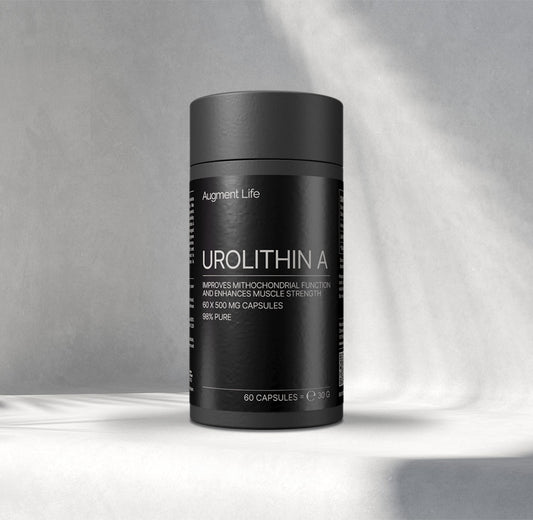
Urolithin A: 500 mg of urolithin A per HPMC capsule, in packs of 60 or 120.
Food supplements are not a substitute for a varied, balanced diet and a healthy lifestyle. This article is not medical advice.
Kothe B, Klein S, Petrosky SN. Urolithin A as a potential agent for prevention of age-related disease: a scoping review. Cureus. 2023;15(7):e42550. https://doi.org/10.7759/cureus.42550
Ryu D, Mouchiroud L, Andreux PA, Katsyuba E, Moullan N, Nicolet-dit-Félix AA, et al. Urolithin A induces mitophagy and prolongs lifespan in C. elegans and increases muscle function in rodents. Nature Medicine. 2016;22(8):879-888. https://doi.org/10.1038/nm.4132
Cortés-Martín A, García-Villalba R, González-Sarrías A, Romo-Vaquero M, Loria-Kohen V, Ramírez-de-Molina A, et al. The gut microbiota urolithin metabotypes revisited: the human metabolism of ellagic acid is mainly determined by aging. Food & Function. 2018;9(8):4100-4106. https://doi.org/10.1039/c8fo00956b
Xian W, Yang S, Deng Y, Yang Y, Chen C, Li W, et al. Distribution of urolithins metabotypes in healthy Chinese youth: difference in gut microbiota and predicted metabolic pathways. Journal of Agricultural and Food Chemistry. 2021;69(44):13055-13065. https://doi.org/10.1021/acs.jafc.1c04849
Andreux PA, Blanco-Bose W, Ryu D, Burdet F, Ibberson M, Aebischer P, et al. The mitophagy activator urolithin A is safe and induces a molecular signature of improved mitochondrial and cellular health in humans. Nature Metabolism. 2019;1(6):595-603. https://doi.org/10.1038/s42255-019-0073-4
Singh A, D'Amico D, Andreux PA, Fouassier AM, Blanco-Bose W, Evans M, et al. Urolithin A improves muscle strength, exercise performance, and biomarkers of mitochondrial health in a randomized trial in middle-aged adults. Cell Reports Medicine. 2022;3(5):100633. https://doi.org/10.1016/j.xcrm.2022.100633
Liu S, D'Amico D, Shankland E, Bhayana S, Garcia JM, Aebischer P, et al. Effect of urolithin A supplementation on muscle endurance and mitochondrial health in older adults: a randomized clinical trial. JAMA Network Open. 2022;5(1):e2144279. https://doi.org/10.1001/jamanetworkopen.2021.44279
Whitfield J, McKay AKA, Tee N, McCormick R, Morabito A, Karagounis LG, et al. Evaluating the impact of urolithin A supplementation on running performance, recovery, and mitochondrial biomarkers in highly trained male distance runners. Sports Medicine. 2025;55(12):3183-3200. https://doi.org/10.1007/s40279-025-02292-5
Dao T, Nguyen TT, Gariani K, Kim HJ, Ryu D. Effects of urolithin A supplementation on muscle health outcomes in humans from randomized controlled trials. Frontiers in Nutrition. 2026;13:1834344. https://doi.org/10.3389/fnut.2026.1834344
Denk D, Singh A, Kasler HG, D'Amico D, Rey J, Alcober-Boquet L, et al. Effect of the mitophagy inducer urolithin A on age-related immune decline: a randomized, placebo-controlled trial. Nature Aging. 2025;5(11):2309-2322. https://doi.org/10.1038/s43587-025-00996-x
da Costa Pinaffi-Langley AC, Gulej R, Kaposzta Z, Szarvas Z, Shahriari A, Kinnard H, et al. Urolithin A and endothelial and cerebrovascular function in middle-aged adults with obesity: a randomized clinical trial. JAMA Network Open. 2026;9(10):e2638047. https://doi.org/10.1001/jamanetworkopen.2026.38047
Hodzic Kuerec A, Lim XK, Khoo ALY, Sandalova E, Guan L, Feng L, et al. Targeting aging with urolithin A in humans: a systematic review. Ageing Research Reviews. 2024;100:102406. https://doi.org/10.1016/j.arr.2024.102406
Shopping bags feel heavier than they used to. Getting up from a low sofa takes a push from the armrest, and a long flight of stairs is something you now...
Shopping bags feel heavier than they used to. Getting up from a low sofa takes a push from the armrest, and a long flight of stairs is something you now...