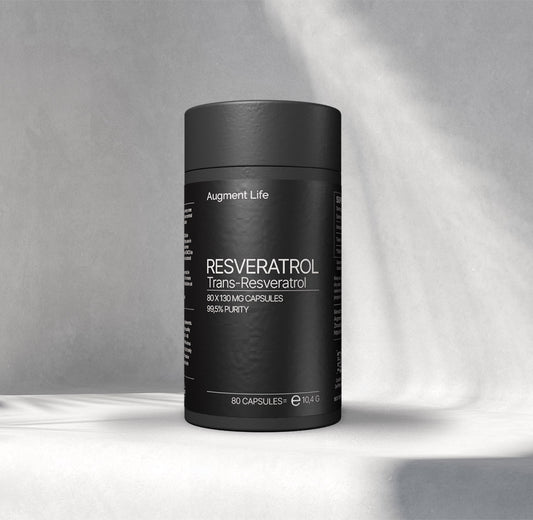
Peter Attia en David Sinclair, twee van de meest erkende namen in de geneeskunde rondom een lang leven, hebben tegenovergestelde visies over de vraag of resveratrol een lang leven ondersteunt. Attia heeft de waarde ervan voor een lang leven publiekelijk van de hand gewezen en haalde daarbij de mislukte replicatie aan van het sirtuïne-onderzoek erachter (1). Sinclair, de Harvard-geneticus die resveratrol op de kaart zette, neemt zelf nog steeds elke ochtend ongeveer een gram (2). Resveratrol is ook bestudeerd voor andere gezondheidsresultaten, en hier bekijken we wat het bewijs wel en niet ondersteunt, en waarom.
Wat is er gebeurd met de claim over een lang leven?
Het resveratrol-verhaal begon in 2003, toen Sinclairs lab meldde dat het de levensduur van gist verlengde door een sirtuïne-enzym te activeren dat gekoppeld is aan stressresistentie en caloriebeperking. Bij mensen staat dit enzym bekend als SIRT1, centraal in het resveratrol-verhaal dat volgde (3).
Het idee werd in 2006 doorgetrokken naar zoogdieren, toen resveratrol de overleving verbeterde bij muizen op een calorierijk dieet en de sterfte met ongeveer een derde verminderde, hoewel die muizen ook door voeding veroorzaakte leververvetting hadden, dus het voordeel kan bescherming tegen die schade zijn geweest in plaats van langzamere veroudering (4).
Het vervolgbeewijs is niet overeind gebleven. Op een gewone voeding verbeterde resveratrol enkele markers van gezond ouder worden bij muizen, maar verlengde het de levensduur niet (5). Het onderliggende SIRT1-mechanisme werd ook in twijfel getrokken toen het effect bleek af te hangen van hoe de labtest was ontworpen in plaats van een echt biologisch effect (6). Een strengere, door de overheid gefinancierde proef op meerdere locaties bevestigde het negatieve resultaat voor de levensduur, zelfs al verlengde een vergelijkbaar medicijn dat ernaast werd getest de levensduur wel (7).
Bij mensen vond een van de sterkste langetermijnstudies geen verband tussen natuurlijke blootstelling aan resveratrol en sterfte, hart- en vaatziekten, kanker of ontstekingen bij bijna 800 oudere volwassenen gedurende negen jaar, hoewel het de voeding meette in plaats van suppletie (8). Alles bij elkaar blijft het mechanisme bij mensen slechts gedeeltelijk bevestigd, en de sterkste data ondersteunen geen voordeel voor een lang leven.
Wat laten humane studies op andere gebieden zien?
Los van een lang leven is resveratrol getest op specifieke gezondheidsmarkers.
- Cardiovasculaire gezondheid: Een druivenextractsupplement met slechts 8 mg resveratrol naast andere polyfenolen verminderde geoxideerd low-density lipoproteïne (LDL) en apolipoproteïne B (ApoB) bij patiënten met cardiovasculair risico die statines gebruikten gedurende zes maanden (9); een afzonderlijke studie van 30 dagen bij zwaarlijvige mannen vond metabolische verbeteringen, waaronder insulinegevoeligheid (10). Resultaten voor bloedvaten zijn wisselend: 270 mg verbeterde flow-mediatieve dilatatie, een marker voor de gezondheid van bloedvaten, bij volwassenen met overgewicht of hypertensie, maar 150 mg/dag gedurende vier weken had geen effect op de endotheliale functie of ontsteking (11).
- Type 2-diabetes en cardiometabool risico: Een meta-analyse van 17 studies bij 1.337 mensen met type 2-diabetes vond resveratrol een van de beter presterende opties voor insulinerresistentie, lipidenprofiel en bloeddruk, hoewel de rangschikking per uitkomst versilde (13). Een afzonderlijke studie van 24 weken met 200 mg per dag verminderde HbA1c, nuchtere insuline, HOMA-IR, CRP en IL-6, zonder verandering in cholesterol of triglyceriden (14). Een andere studie bij mensen met goed gereguleerde type 2-diabetes vond geen verbetering in insulinegevoeligheid of intrahepatisch vet, hoewel een metaboliet correleerde met de metforminedosis, wat suggereert dat metformine het metabolisme ervan beïnvloedt (15).
- Botgezondheid: Een gerandomiseerde studie wees uit dat 75 mg resveratrol tweemaal daags de botmineraaldichtheid in de lumbale wervelkolom en dijbeenhals verbeterde bij postmenopauzale vrouwen gedurende 12 maanden (16).
- Polycysteus-ovariumsyndroom (PCOS/PMOS): Kleine studies melden verbeteringen in sommige hormoon- en ontstekingsmarkers, hoewel het bewijs beperkt blijft (17, 18).
Waarom opname nog steeds belangrijk is
De lage biologische beschikbaarheid van resveratrol is een terugkerende beperking in deze onderzoeken. Het wordt goed opgenomen, maar het lichaam breekt het meeste snel af, waardoor de bloedwaarden ver onder blijven van wat labstudies gebruiken om een effect te zien (19). Die kloof is precies waar afgiftetechnieken zoals liposomale insluiting voor zijn ontworpen.
Hoe zit het met de veiligheid?
Bij 100 tot 1.000 mg per dag wordt resveratrol over het algemeen goed verdragen, hoewel gastro-intestinale bijwerkingen vaker voorkomen bij hogere doseringen.
- Leverenzymen: Bij 1.000 mg per dag gedurende vier weken veranderde het verschillende leverenzymen bij gezonde vrijwilligers, wat het vermelden waard is vanwege geneesmiddelinteracties (20).
- Bloedverdunners: Bij ratten verhoogde het de blootstelling aan warfarine en het anticoagulante effect ervan, een mogelijke zorg voor mensen die bloedverdunners gebruiken, hoewel dit niet is bevestigd bij mensen (21).
- Nierfunctie: Problemen doken alleen op in een kankeronderzoek waarin ongeveer 5 g per dag werd gebruikt, ver boven de typische doseringen en bij patiënten die al kwetsbaar waren voor nierfunctiestoornissen (22).
De conclusie
De claim van resveratrol voor een lang leven houdt geen stand onder de loep: de wetenschap die eraan ten grondslag lag, heeft zich niet vertaald in een bewezen voordeel voor de mens. De meer veelbelovende ondersteuning uit humane studies ligt elders, namelijk bij cardiovasculaire risicomarkers, type 2-diabetes, PCOS/PMOS en botdichtheid, hoewel de bevindingen niet consistent zijn in elk onderzoek. Geen van deze zijn op zichzelf uitkomsten voor een lang leven, maar het beheersen ervan maakt deel uit van wat het inhouden van een langer, gezonder leven, en dat is waar het huidige bewijs naar wijst.
Lees meer:Liposomaal resveratrol: voordelen en de aanbevolen dosering en Wat is beter, NMN of NR? en Liposomaal NR: maakt het een verschil??
Literatuurbronnen
- Top Aging Expert Peter Attia Discusses NAD+ Precursors. nad.com. https://www.nad.com/news/top-aging-expert-peter-attia-discuss-nad-precursors-taking-nmn-and-nr-together
- Dr. David Sinclair's Supplement List. Brainflow. https://brainflow.co/dr-david-sinclairs-supplement-list-for-longevity/
- Howitz KT, Bitterman KJ, Cohen HY, et al. Small molecule activators of sirtuins extend Saccharomyces cerevisiae lifespan. Nature. 2003;425(6954):191-196. https://doi.org/10.1038/nature01960
- Baur JA, Pearson KJ, Price NL, et al. Resveratrol improves health and survival of mice on a high-calorie diet. Nature. 2006;444(7117):337-342. https://doi.org/10.1038/nature05354
- Pearson KJ, Baur JA, Lewis KN, et al. Resveratrol delays age-related deterioration and mimics transcriptional aspects of dietary restriction without extending life span. Cell Metabolism. 2008;8(2):157-168. https://doi.org/10.1016/j.cmet.2008.06.011
- Pacholec M, Bleasdale JE, Chrunyk B, et al. SRT1720, SRT2183, SRT1460, and resveratrol are not direct activators of SIRT1. Journal of Biological Chemistry. 2010;285(11):8340-8351. https://doi.org/10.1074/jbc.M109.088682
- Miller RA, Harrison DE, Astle CM, et al. Rapamycin, but not resveratrol or simvastatin, extends life span of genetically heterogeneous mice. The Journals of Gerontology: Series A. 2011;66A(2):191-201. https://doi.org/10.1093/gerona/glq178
- Semba RD, et al. Resveratrol Levels and All-Cause Mortality in Older Community-Dwelling Adults. JAMA Internal Medicine. 2014. https://doi.org/10.1001/jamainternmed.2014.1582
- Tomé-Carneiro J, et al. Consumption of a grape extract supplement containing resveratrol decreases oxidized LDL and ApoB in cardiovascular risk patients: a triple-blind, 6-month follow-up, placebo-controlled, randomized trial. Molecular Nutrition & Food Research. 2012. https://doi.org/10.1002/mnfr.201100673
- Timmers S, et al. Calorie restriction-like effects of 30 days of resveratrol supplementation on energy metabolism and metabolic profile in obese humans. Cell Metabolism. 2011. https://doi.org/10.1016/j.cmet.2011.10.002
- Ramírez-Garza SL, Laveriano-Santos EP, Marhuenda-Muñoz M, Storniolo CE, Tresserra-Rimbau A, Vallverdú-Queralt A, Lamuela-Raventós RM. Health Effects of Resveratrol: Results from Human Intervention Trials. Nutrients. 2018;10(12):1892. https://doi.org/10.3390/nu10121892
- Dr. David Sinclair's Supplement List. Brainflow. https://brainflow.co/dr-david-sinclairs-supplement-list-for-longevity/
- Miao R, Zhang B, Zhou D, et al. Clinical Efficacy of Curcumin, Resveratrol, Silymarin, and Berberine on Cardio-Metabolic Risk Factors Among Patients With Type 2 Diabetes Mellitus: A Systemic Review and Bayesian Network Meta-Analysis. Phytotherapy Research. 2025. https://doi.org/10.1002/ptr.8431
- Mahjabeen W, Khan DA, Mirza SA. Role of resveratrol supplementation in regulation of glucose hemostasis, inflammation and oxidative stress in patients with diabetes mellitus type 2: A randomized, placebo-controlled trial. Complementary Therapies in Medicine. 2022;66:102819. https://doi.org/10.1016/j.ctim.2022.102819
- Timmers S, et al. Resveratrol as Add-on Therapy in Subjects With Well-Controlled Type 2 Diabetes: A Randomized Controlled Trial. Diabetes Care. 2016;39(12):2211-2217. https://doi.org/10.2337/dc16-0499
- Wong RHX, et al. Regular Supplementation With Resveratrol Improves Bone Mineral Density in Postmenopausal Women. Journal of Bone and Mineral Research. 2020. https://doi.org/10.1002/jbmr.4115
- Fadlalmola HA, Elhusein AM, Al-Sayaghi KM, et al. Efficacy of resveratrol in women with polycystic ovary syndrome: a systematic review and meta-analysis of randomized clinical trials. The Pan African Medical Journal. 2023. https://doi.org/10.11604/pamj.2023.44.134.32404
- Brenjian S, et al. Resveratrol treatment in patients with polycystic ovary syndrome decreased pro-inflammatory and endoplasmic reticulum stress markers. American Journal of Reproductive Immunology. 2020. https://doi.org/10.1111/aji.13186
- Szymkowiak I, et al. Resveratrol Bioavailability After Oral Administration. Phytotherapy Research. 2025. https://doi.org/10.1002/ptr.8379
- Chow H-HS, Garland LL, Hsu C-H, et al. Resveratrol modulates drug- and carcinogen-metabolizing enzymes in a healthy volunteer study. Cancer Prevention Research. 2010;3(9):1168-1175. https://doi.org/10.1158/1940-6207.CAPR-09-0155
- Huang TY, Yu CP, Hsieh YW, Lin SP, Hou YC. Resveratrol stereoselectively affected (±)warfarin pharmacokinetics and enhanced the anticoagulation effect. Scientific Reports. 2020;10:15910. https://doi.org/10.1038/s41598-020-72694-0
- Popat R, Plesner T, Davies F, et al. A phase 2 study of SRT501 (resveratrol) with bortezomib for patients with relapsed and/or refractory multiple myeloma. British Journal of Haematology. 2013;160(5):714-716. https://doi.org/10.1111/bjh.12154